Showing posts with label Geysers. Show all posts

Thursday, 1 March 2012

Minor Forms of Extrusive Volcanic Activity


Geysers and Hot Springs :- Even in areas where vulcanism does not generate active volcanies, water heated at depth in the crust by magma chambers can periodically escape as steam and hot water. A geyser is an intermittent turbulent discharge of superheated water ejected and accompanied by a vapour phase. Where hot water on its way upwards mixes with muds near the surface, a bubbling, boiling mud volcano may form. In some places hot springs have become tourist attractions: in Pamukkale (Turkey), dissolved salts from the hot water are lard down in spectacular calcium carbonate deposits, though the area is not volcanically active (read past post on this here).
Geysers
- hot pressurised water, stored in rock cavities underground which increases pressure
- normally find a small mound surrounding a pool of water. The water is very mineral enriched and when it 'splatters' minerals are deposited, forming the mound.
- pools are incredibly colourful due to dissolved minerals
- periodically form a fountain
i.e Old Faithful (Yellowstone National Park), Geysir (Iceland), New Zealand
RISKS - hot water and sulphurous gases
BENEFITS - tourism and geothermal energy exploitation oppurtunities

Hot Springs
- pool of warm geothermally heated water
- less pressurised water, hence no fountains
- water laden with minerals
i.e Japan, BlueLagoon (Iceland - technically a manmade version)
RISKS - very hot water
BENEFITS - tourism and social
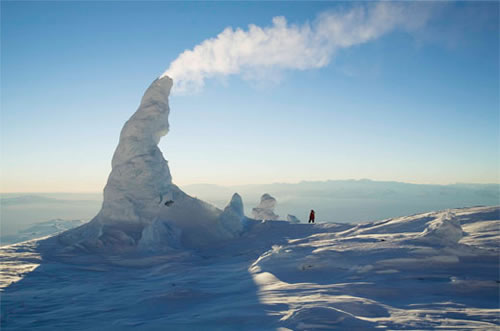
Fumaroles:- Fumaroles are ares where superheated water turns to steam as it condenses on the surface. Personally, I think they look most spectacular when they form in ice, like those on Mount Erebus (this a film review but also contains a description of such fumaroles)

Fumaroles
- superheated water turns to steam, rises and deposits minerals to form chimney-like structures
i.e Stromboli, Erebus
RISKS - hot steam and sulphorous gases
BENEFITS - tourism and mineral extraction

Mudpots
- water geothermally heated, interacts and mixes with mud and surface deposits
i.e Vulcano
RISKS - slightly radioactive and very hot
BENEFITS - tourism


Monday, 11 April 2011

Geysers

I am aware that most of my posts over recent weeks have just been lots of writing and I am conscious that over the next week, as I finish some posts I am working on and move on to type up some revision notes, that there will be a lot more to come. So, I thought (and I welcomed this break) that I would write a short post with a few pictures to help me describe how geysers form - yes I know its a bit random but I fancied a break from meanders, the DTM and wind turbines!

What is a geyser?
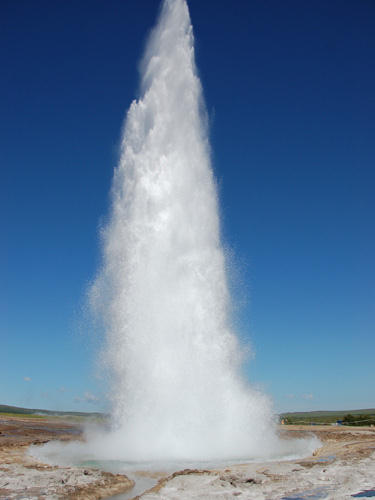
A geyser is a fountain of steam and water that erupts from the ground under pressure from a reservoir of superheated water below the surface.

How are they formed?
Silica seems to play an important role in the formation of geysers as, as the silica rich superheated water (the groundwater is so hot due to the fact that they form in areas of volcanic rock) makes its way up towards the surface the silica is slowly deposited on the walls of the channels/tunnels. This creates a water tight plumbing system which, as the water travels through it, constricts the flow close to the surface. This increases the pressure and allows the temperature of the water to remain above its boiling point in a reservior above the surface. As the temperature continues to increase, pockets of water at the bottom turn to high pressured steam which forces its way out of the constricted opening. This provokes a sudden decline in pressure which instantly causes the superheated water to boil, causing a jet of steam and water to explode out of the ground. Geysers sometimes erupt from within pools but, if they don't, a concial structure created by silica deposits (known as geyserite - I think???) gradually develops.


Where can they be found?
The majority of the time, geysers form in groups known as geyser fields in areas where the underground heat and volcanic rock formations produce the required conditions. There are estimated to be around 1000 geysers across the globe and Yellowstone Park contains about half of them, including Old Faithful which erupts every 90 minutes, shooting thousands of gallons of water around 185ft into the air. Yellowstone is also home to the largest geyser in the world (Steamboat - see image below) which, although rather infrequently, shoots hot water up to 400ft (120metres) into the air! Geysers can found in Chile, New Zealand, Alaska and Iceland too, amongst a few other countries. The time between eruptions varies from geyser to geyser and can be anything from a few minutes to several years.