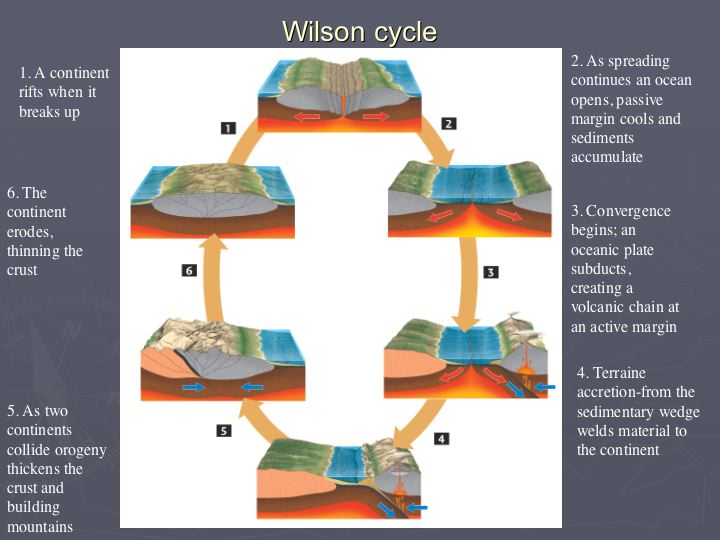
Rifting controls the opening and closing of oceans. The cycle is known as the Wilson Cycle and it illustrates the balance between new crust being created by volcanic eruptions and destruction of crust at subduction zones, to maintain Earth's fixed size. This helps to explain why there are subduction zones at the edges of most continents.
There are various stages to the Wilson Cycle and each one can be seen in operation across the world today:
-
The embryonic stage, involves uplift and
continental crust extention, resulting in the the formation of rift valleys (e.g.
the East African Rift System).
-
The young stage involves the evolution of rift valleys into spreading
regions with thin strips of ocean crust between the rifted continental sections.
This forms a narrow, parallel-sided sea, like the Red Sea that is
opening between NE Africa and Arabia.
-
The mature stage is characterised by widening of basin and
its continued development into a major ocean flanked by continental shelves and
with the continual production of new, hot, oceanic crust along the ridge
(e.g. Atlantic Ocean).
-
Eventually, this expanding system becomes unstable and, away from the ridge,
the oldest oceanic lithosphere sinks back into the asthenosphere, forming an
oceanic trench subduction system, such as the situation in the
western Pacific Ocean. Onset of subduction at the
ocean boundary marks the subduction stage (e.g. the Pacific
Ocean).
-
Once subduction overtakes formation of new crust at the constructive
boundary, the ocean begins to 'shrink'. Island arc's collide and create young
mountain ranges around the periphery of the 'shrinking' ocean. This marks the terminal stage of the cycle (e.g. the Mediterranean).
-
The end stage occurs when all the oceanic crust between the
continental masses has subducted, and the continents converge along a collision
zone characterised by an active fold mountain belt, such as the Himalayas.
The plate boundary becomes inactive, but the boundary between the two plates remains as a zone of lithospheric weakness. Therefore it has the potential to the site of a new rift and so the
cycle continues.