Monday, 31 October 2011

Global population = 7 Billion

UN predictions suggest that today the world's population reaches a staggering 7 billion and I have to admit that it is pretty cool, although slightly scary, to think that I share my birthday with the 7 billionth inhabitant of Earth -  quite fitting considering it is Halloween!

The graph above illustrates where I fit into the picture - 5,582,734,706th person when I was born, making me the 80,819,731,395th person ever alive on Planet Earth - follow the link to find out which 1 of 7 billion you are....

I realise you are not going to be short of things to read on this topic over the coming weeks so I am not going to delve to much into the details of this pretty historic moment but first up for a few statistics that I am sure we could all slip into a Geography essay (or two!) over the common year...

Globally, every hour there are:
- 15,347 births
- 6, 418 deaths
= Average yearly increase of +1.162%
Fast-growing country is Qatar at +514 people per day
Fast-shrinking country is Moldova at -106 people per day

Highest life expectancy is in Japan at 82.7 years
Lowest life expectancy is in the Central African Republic at 45.9 years

97/100 new people on the planet are currently being born in developing countries

In the UK, the population is around 62156764 and every hour there are:
- 85 births
- 66 deaths
- +23 immigrants
= Average yearly growth of 0.6%
Average life expectancy is 79.6 years (81.7 for females and 77.4 for males)

It is quite hard to visualise all these statistics regarding population expansion but this interactive graphic produced by the Guardian, based on the UN projections, is quite good, especially when aiming to make comparisons between countries. Whilst talking about the Guardian and the resources they offer, they are very good at reporting on development and environmental issues and so checking up on that ever so often would be a good way to keep up with your independent reading, or if you are likely to forget to check you can like the facebook pages for both. However, if the thought of reading lots doesn't really excite you much then they also produce podcasts which are not too long and quite interesting to listen to - I find some of them quite good for helping me form opinions on this human geography stuff - here is the link to a recent podcast on population growth.

Whats next? Will people numbers stop rising?
The global population is expected to continue to increase during the course of this century, reaching 10 billion by 2083 - follow the link above to see a clip that illustrates this quite well. However, the rate of this growth is expected to slow in comparison to the rapid rate of exapnsion witness over the last 100 years. Little of this growth is happening in countries such as the UK, who are expected over coming years to see a drastic reduction in growth with many possibly experiencing negative growth. Instead, the growth is occuring in the developing world - with Asia presently experiencing most growth although this is soon likely to switch to Africa. We have recently placed quite a bit of focus on to the issues of ageing populations and so it is easy to forget that the world's population is actually quite young, with 43% under 25 (this constitutes 60% of the population across developing countries).

I have been struggling to know what excatly to write but the idea of writing a letter to the 7 billionth person caught my eye so I thought I would give it a try.......

Dear 7 billionth person,

First up, welcome to the world! We havent really been looking after Earth that well and unless we start to change our attitude then the future does not really look that bright......

I am trying really hard not to start on a negative but I have to admit its not easy. 7 billion people on the planet - I doubt if you said that 50 years ago anyone would have believed you, especially in the given timescale. 1 billion people added to the planet in 12 years is crazy and worryingly, for a while atleast, the rate of population expansion could continue to accelerate before it begins to slow down - I would love to know what Thomas Malthus would think about this all if he was still alive today. Anyway, whilst its easy to focus on all the doom and gloom that the future may hold, I think that this historic moment in time warrants us all to sit back and reflect, reflect on the progress made my mankind over the past few centuries. As a race we have come so far and the fact that I can stand here today and say that the global population has reached 7 billion is real testament to the great thinkers of  past generations who have solved so many of the problems society has face. Yes, we have made some huge mistakes in the past, and prevail to do so, but enough of us have learnt from this to allow for progress to be made. If you are born into a developed country (although this is unlikely considering 97/100 babies are born in developing countries) you will have access to all the simply remarkable scientific discoveries and technological advancements that have been made and therefore we be able to experience the best that we have so far achieved. If you are fortunate enough to be granted this luxury, please don't be ignorant to the fact, like so many, that the world is full of inequality, poverty is rife and suffering is an unnerving norm for so many. Suffering extends to the environment we inhabit and there is no hiding the fact our current status has been built on unsustainable foundations whilst we continually threaten our world in an unacceptable and, possibly, unforgivable way.....

Perhaps, its good that the UN have decided not to name the 7 billionth inhabitant of Earth as I feel a lot of responsiblilty would have been placed on you. Instead I think the number and the idea itself that there are 7 billion people on planet Earth should be enough (hopefully!) to shock people into changing - if we don't change (and soon!) then the thousands of children born each day are only going to inherit problems, problems generated by our ignorance and arrogance. Unification is what is required as we all need to act together if our efforts are to have the desired effect. Of course, politcans and public figures leading the way will help but we need to want to change for ourselves and the good of mankind. Hopefully the symbolic nature of your existance should catalyses the reaction needed to bring about required change but we are, as a global community, quite unpredictable and do some strange things, our persistant abuse of the Earth's finite resources even though we are fully aware of the consequences just one example.

You symoblise perfectly the issue of over-population, an issue that needs to be addressed, especially as we seem intent on continuing the unsustainable lifestyles a significant amount of us lead. This problem is slightly trickier to solve than environmental issues, to some extent, as why should we have the right to dictate how many children a couple can have. Its one that, until recently, has not been publicised enough across the world and is an issue that will only get worse before it gets better. Whilst I understand the theory behind possible solutions to this issue I am not confident enough to offer a solution, as to most of the problems this world faces, but I live in hope that one day someone will and we will all listen. When that day will be, who knows, but if current trends continue it is likely to be the time at which it is almost too late. Sounds a little skeptical I know but that seems to be the way the world works these days..... we fail to change until our bank accounts feel the impacts!

Advice I can give you...... well I cannot really offer you much in the way of life advice apart from enjoy it, make the most of any access you can get to education (it really is the key to the future), be yourself, help others to the best of your ability and strive to make a difference. Don't live in the past but don't ignore it, learn from the mistakes some have made. Adaptablity is going to be the key in the future, we have messed with systems we are yet to fully understand and thus the consequences are unknown, so we have to be prepared to adapt to the coming changes and make comprimises with the environment we live in. Whatever you do, just don't lose hope with the human race, unpredictability can work both ways and hope is all that some have. It is easy to look at the future and give up but we have always found ways in the past, and hope in the future is the only way forward. If you want to really do something with your life when you are older, and be able to offer solutions to the problems our and future generations face, then become a scientist/politican. This world needs another great thinker, someone who is willing to take the risk of looking far outside the box and take a chance on their gut feelings. Whilst we currently have many great scientists who are making advancements towards understanding the impacts of anthropogenic forcing, we are in desperate need of someone who can understand this knowledge, convey it to the wider audience in a way that will grap their attention and demand their support. We need someone that can unite the world, which I realise sounds strange considering we all pretty much  share the same common goal and are more connected to each other than even before. I fear that, if we are not carefull, the resource war, which could be immentent, will be catastrophic and leave the world in an even worse state than before. This resource war, at present, may remain a theory held by many but I believe we will all learn to fear the idea, especially when the unnerving probability of it occuring not too far in the future becomes public knowledge - a war that could easily violently erupt within our lifetimes.

The symbol you form could start to unite the world and make us reflect, with the words 7 billion, I am sure, spoken far more than 7 billion times tomorrow. Its key we allow this milestone passing to have some form of resonance so in  years time we can identify this date as a key turning point in the history of mankind.....

......the day humanity decided to stop, think, reflect and ultimately change

Well I live in hope! Good luck in the future, I wish you all the best in life and what you decide to make of it.

Vicki


Writing that I harder than I thought it would be and I have perhaps been slightly skeptical (poor kid!). What would you say to the 7 billionth inhabitant on Earth, any advice or warnings you would give them?

Wednesday, 19 October 2011

What should be the top environmental priority for the next 40 years?

Last week, in London, some of the world's experts in environmental change and challenges gathered, as part of Earthwatch, to discuss what aspect of environmental change should be our priority for the next 40 years. So, what factors came up during the discussion...........

Education and Population:

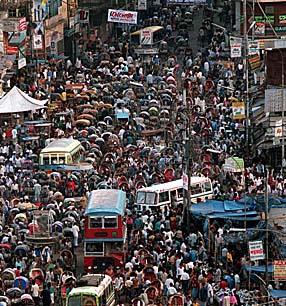
Since the beginning of the industrial revolution some 250 years ago, we have changed the character of the Earth;  hence the increasing use among geologists of the term Anthropocene to follow the Holocene epoch. Although a complex mix of factors are responsible for such changes, population growth is without a doubt the most dominant - and continues to be. The human population rose from around one million 12,000 years ago to around one billion 250 years ago. Since then there has been an extraordinary acceleration from 2 billion in 1930 to 6 billion at the end of the century and now approaching 7 billion this month, with projections suggesting a further rise (albeit at a slower rate) to 9 billion by 2045 - scary thought if ask me!!! As hopefully you have gathered from the AS Population module and our current Development A2 module, education is critical if we hope to solve the issue of population growth and thereby dilute the effect of the appending impacts - especially education of women ( = the Girl Effect) as where emancipation of women is achieved, CBR drastically drops, as seen in most industralised countries where the fertility rate is below replacement level fertility. However, in reflection, this does causes problems in its own right - think ageing populations - but, with regards to the environment, is no where near as detrimentally damaging. There are also many other issues such as increasing population density and rapid urbanisation, especially in the developing world, which are all causing global societal problems with secondary economic, political and environmental impacts.  To think that global education could attenuated many of these demographic issues is incredibe - if education is the answer, something which is perhaps possible to start to globally implement on the mentioned timescale, should it be our priority for the next 40 years?

Oceans:

I will try and keep this one short and simple as in truth I could probably write a few essays for you on this one! Approximately 70% of the globe is ocean and we are incredibly connected and consequently reliant on it in a multitude of ways. The oceans (although specifically the ocean circulation)  are a critical mechanizism in the Earth's heat transfer system, feeds over 25% of our population and, as a result of its close coupling with the atmosphere, absorbs the heat generated by our unhealthy addiction to burning fossil fuels. Although the oceans may look very stable and unchanged over recent decades, they are not, and are increasingly vulnerable to anthropogenic forcing. With more photosynthesis occuring on the sea surface than anywhere else, many consider that the oceans breathe for the planet, with the oceans also being the largest carbon sink. This is all set to change, if our unsustainable environmental usage and consequentially accentuated global climate change continues to happen and once a significant change happens within the oceans (as is already happening with depletion of the oceans fisheries, toxic contamination of the sea by industrial runoff and plastic pollution and acidification etc.) it will pose a great threat to the health of the world's population.

Water:

Water is a resource that many take for granted but it is a resource that we simply cannot survive without. Whilst we cannot live without it, when we are forced to drink that which is not clean it becomes lethal with diarrhoea the biggest killer of children in sub-Saharan Africa - preventable diarrhoea associated with dirty water and poor sanitation kills more children than Aids, malaria and TB combined.Water provokes other societal issues, especially for women and girls who bear the burden in developing countries of walking for miles in search of water whilst dirty water, poor sanitation and hygiene undermines maternal and child health and nutrition. This has knock on impacts on education, with 443 million schools lost due to water-related diseases, as girls, especially, are needed to find water thus cannot attend school. The World Health Organisation estimates that every $1 invested in water generates $8 in wider economic benefits. All of the above, are linked to water as a drinking resource, but it has wider uses to, in industry and agriculture. Agriculture is reliant on water supplies, with 70% of the globally available freshwater used for agriculture, making livelihoods even more reliant on water what with droughts and famines going hand in hand. It is a critical ingredient for industry - almost every manufacturing process needs water - whilst,  it's intertwined with energy and not just through hydropower but thermal power stations need water for cooling and for the steam needed to turn turbines.

Energy:

I am guessing that this one is quite obvious - we humans are different to other species on Earth as not only do we gain energy from the things we eat but also from things that we don't eat. Our energy usage throughout our history has changed, as both a consequence of our development and as a factor allowing for our development. Currently, the issue of generating energy sustainably is a huge issue for the global community, with climate change accelerated by our insatiable hunger for burning fossil fuels, a desire that is only likely to increase as the global population continues to grow and countries continue to reach higher levels of development.

Food security:

With water security and supplies under threat, whilst the population continues to expand, the challenge of feeding the world is a huge! This challenge is not going to be easy with our oil-reliant food system, our environment under stress from global climate change, distruption to water supplies and soil degradation/loss, weakening overturning in oceans, biodiversity loss, land use competition with people and animals needing space to live, space needed to grow food and people starting to utilise fertile land for energy production. Perhaps one of the greatest challenges is changing our attiutde towards food and waste as if every country fed its population to the extent that we do in the UK or the USA, we would need several planets just to grow food, with estimates that 40% of what is fit to eat we waste. If we have to feed 9 billion people by 2045 we cannot continue in the way that we are - especially if you factor in the likely future changes to agriculture patterns and productivity as a result of global climate change.


What do I think? Well, I think that just the above mentioned are cause for concern and there are other factors that I am shocked did not get on the list. We place a lot of focus on how oil fuels fighting and whilst it cannot be argued that it doesn't, I think greater focus should be placed on possible/likely future fighting over resources that are essential to our survival - primarily water and food. If we are prepared to start wars over oil what would countries be prepared to do when the resource we are all after is one intrinsic our survival. This is worthy of a few blog posts on its own but I am reading a really interesting, if not slightly worrying, book at the moment called Climate Wars which covers this - a book review will be on its ways shortly, once I have finished reading it, but it is definetly worth a read for any Geographer! Anyway, back to the question,  to be honest, I feel that all these factors (and many many more) are so closely interlinked that we cannot hope to untangle them and thus it is crucial that instead of trying to prioritise them we spend the time discussing how to prevent worse case scenairo's from occuring by developing mitigation techniques whilst also ways in which society can adapt to the inevitable consequences of the damage already caused by humankind. So, I suppose what I am trying to say is that I believe we need a more holistic approach to environmental change rather than trying to prioritise different aspects.

Anyway, the afore mentioned are the factors covered during Earthwatch, followed by my view for the need for a holistic approach but what do you think should be the top environmental priority for the next 40 years? Would you choose one of the above or do you think something is missing from the list? Let me know what you think!

I am a bit reluctant to tell you which of the above factors was voted to be the greatest environmental challenge and thus should be our priority over the next 40 years but I am guessing I probably should tell you and anyway, hopefully, by now you will have formed your own opinion. The chosen factor was Population and Education with the agruement for the desperate requirement to address expotential population growth and providing education for all, viewed as the most compelling. The speech given by Sir Crispin Tickell, on this topic, can be replayed here - do you agree with the factor chosen?

Friday, 7 October 2011

Geography Picture of the Week - Kerala churches rewarding big families

I realise that this week's Geography Picture of the Week post is not particularly centred one specific picture but I just read this story online and thought that it may be of some interest and, as an added bonus, it is related to human geography and links can be made to our current module.....

Hindu groups have said the two child policy should be imposed as
 there are limited resources
It seems like ages ago that we studied the AS population module but do you remember that really interesting case study of Kerala, in India, that we learnt about. Well I am guessing that it is probably quite a good case study to know a little bit about for this current module - here is the basics incase you have forgotton.......

KERALA :- Kerala is a really good case study to know about as it is an anomally to the general pattern between population and development indicators in LDC's/MDC's and it also demonstrates the spatial differences within countries themselves.
  • Kerala is India's longest lived, healthiest, most gender-equitable and most literate region with one of the best education systems. The state's basic human development indices are roughly equivalent to those in the developed world and the state is substantially more environmentally sustainable than many of the countries in Europe and North America. A survey conducted in 2005 also concluded that Kerala was the least corrupt state in India. Although Kerala is a poor state with a GDP of around $11000, it has very good demographic indicators........
    • Population = 31.8 million
    • Life expectancy = 73.3 years
    • IMR = 20/1000
    • Literacy rate = 96.6%
    • CBR = 14/1000
    • CDR = 6.4/1000
    • TFR = 1.7
  • WHY? 90% of the people own the land they live on, and each family can only have a maximum of 8 hectares. In 1957 a communist government was elected to power and fair price shops and ration cards were introduced to ensure that everyone could afford to eat. This government has a strong commitment to female education and a participatory democracy in which; every 10 years, 10% of the population are invited to meeting to express their views and help make decisions on how to take Kerala forward.

So, what is happening in Kerala at the moment that is so interesting. Well, several Christian parishes, Catholics and Muslim groups in this developed state have started to offer incentives to couples who have more children, with one church reportedly offering 10,000 rupees ($200) for a couple's fifth child. Now in a country with a huge population that is only projected to continue to grow, passing that of China's by 2030 whilst having massive problems with water security which are only likely to worsen as a result of global climate change and with sea level threatening to displace millions; to me this seems like a really strange idea - trust me after spending 10 minutes in an Indian city you will fully appreciate why the last thing this country needs is more people!

The move by local churches comes after a report submitted to Kerala's chief minister proposed imposing a strict two-child policy. So, why excatly are the churches feeling the need to encourage couples to have more children? Some feel it is because the church groups are concerned about the dwindling numbers of Christians in the region; with the lastest censensus showing numbers are in steady decline and risk slipping below 18%. This is probably not really an excuse to pay people to have more children in a country that greatly struggles to provide for its already huge population. If you think back to when we learnt about population policies, you will probably remember all the disadvantages and negatives of the Chinese 'one child policy and many of the same opinions are being aired in Kerala by religious groups, prominetly the view that it is solely a personal decision on how many children a couple should have and consequently the church feels that any finanical punishments placed on couples for having more than two children should not prevent them from doing so and that the ruling encroaches upon the right to religious freedom. These rewards have not be announced by the church statewide yet but many individual parishes are choosing to other incentives in some form, including free treatment and the parish run hospitals. 

Although to many families these incentives will look rather appealing the punishments recently recommended by the panel for the Commission of Rights and Welfare of Women and Children, which include 3 months in prision or a 10,000 rupee fine for any father expecting his third child, are probably harsh enough to put many off.

The Hindu United Front, who strongly support the introduction of this policy, believe that "the two-child norm should be strictly enforced in India as we have limited resources to share among us"and they are definetly right about the country having limited resources when considering its population size!

Let me know what you think! Should a population policy be enforced in India? Does its forever increasing population help or hinder its development?

Sunday, 2 October 2011

Pathway to African development...

Africa are visibly the least developed continent on the globe and, collectively with regards to development ( = the process of social and economic advancements that leads to improvements in peoples quality of life and general wellbeing), are far behind Europe, the forever growing Asia and rapidly developing South America. Groups of countries (not necessarily confined to continents) have developed differently. The Rostow Model of Development represents quite well the stages taken by Europe and the other most developed countries in the world, all of which focused on developing agriculture and then implementing import substitution. On the other hand, the Four Asian Tigers exploited the growing materlistic attitude in the west to allow for a export-driven model of industralisation, and thus development, to be followed. China has been the most recemt recipient of large scale TNC investment due to its abundant and cheap work force and, combined with the resources it has to offer (especially rare earth metals) has continued to grow at, arguably, a worrying rate. South American nations have grouped together, favouring preferential trade, which has worked out really well for them so far as indicated by the 8% grow experienced for the last 5 years. All these groups of countries have adopted fundamentally different paths to the same end goal, some with more success and speed than others.

So, if Africa are to develop, how do you think they will achieve it? Will they follow the path taken by Europe, would it be easier for them to try and replicate the journey undertaken by the Four Asian Tigers, are they likely to recieve sufficient FDI and interest from TNCs to provoke cumulative causation or should they copy what South America are trying (and arguably succeeding ) to do?

I realise that this is a really big, open ended question and is one that I am probably never going to get a definite answer to until it actually happens (thus something that is probably going to annoy/frustrate me for a while - I am still trying to figure out what a stage 6 of the DTM would look like!!!) but I have been trying to do a bit of reading on the subject and get some peoples opinions - let me know if you have any thoughts!

Normally when I ask questions, especially ones like this, I get some rather strange looks and asked why excatly do I want to know the answer or why can't I just accept things and not think to much. So, I didn't really get that far on my quest to find out what people think. However, Millie is often more than willing to entertain my inquisitive nature and consequent questions, so what did she think about future African development.......

"My personal opinion is that they will need to find a way that takes the lessons from previous efforts at development and personalises it to the unique challenges of Africa. I feel that we need to take into account that the world has changed since we developed, and since the Asian Tiger Policy, and that currently lessons could be learnt from the preferential trade taking place in South America which has seen 8% growth for the last 5 years, and that this could be more easily replicated in Africa. The problem will be the complicating factor of peace, in that the cultural differences that are now inherent in many African nations have not been seen to such a degree in other developing countries, and of course the environment is unique to Africa, and we cannot attempt to understand what all this means for the development process without lengthy consultation, and some fairly significant independence for African nations to identify their best option."

Do you agree? I think that I am inclined to agree with some of the things Millie said but perhaps not all and to be honest the more I think about it, the more questions I have!

I read this the other day; 'Africa looks to learn from east Asia's development experiences'; and it presents quite an interesting idea. Although it doesn't touch on South American development as a model for Africa, it explains why countries like Kenya and Ethiopia have started to look at how countries like China have developed/developing and are trying to find ways to adapt that policy to conditions in Africa as a way of developing. It is debateable whether this is as a direct result of the forever increasing Chinese investment across Africa due to the availabilty and oppurtunity to exploit and utilise the abundant raw materials in this money-poor resource-rich continent but there is no right or wrong way to develop.

So, what do I think....... well for a while now I have been struggling to get my head around the idea of a world existing where development is equal amongst all countries and in reflection I think that the main reason for this is because I have taken a 'one-size fits all' approach and attitude to development - an attitude than I immediately, without thinking, presumed would also apply to future African development. With regards to this idea, I felt that perhaps we could never live in a world with equal development as, probably a bit skeptically, I viewed exploitation of a resource (whether that be people, environment, markets etc) as intrinsic to the way in which we developed and that in the present day, exploitation of the same amplitude, especially of people, was incredibly unlikely to happen. I have started to realise that the 'one-size fits all' approach to development is not suitable, appropriate or indeed helpful when trying to determine the future of this continual process and thus is a dangerous trap to fall into - one that I am guilty of tumbling into. Also, remembering that development is in fact a continual process means that, as time passes and the world changes, development will accorrdingly evole with regards to how it occurs, timescales and possibly even how we view it. Instead, I now understand the importance of locality-specific solutions to the development problem as no two locations are the same and, for example, no matter how long you try you could not get any African nation to fit the Rostow Model of Development perfectly. Therefore I agree with Millie when she said that instead of trying to determine which model of development Africa could mirror, it should be about learning lessons from the differing journeys taken in the past. The world is a changed place and previous paths are no longer applicable in the contemporary world that faces numerous different challenges, challenges that are not evenly distributed around the globe. No one can dispute that Africa is a troubled continent and whilst, idealistically, preferential trade like that used in South America could work, at present I am struggling to see how it would perform in reality due to the inherent cultural differences and absence of lasting peace. Peace is arguably the largest complicating factor that is preventing development (although by no means the only obstacle just perhaps the most prevalent in the present day that could be remedied), a factor sadly linked to European colonialism, and this needs to be achieved before Africa is ready to develop. I think this is in actual fact the biggest question with reference to development in Africa..... Are they actually ready to develop? And, if not, when will they be? The conditions in Africa are unique and not found anywhere else on the globe and the shear number of interconnected, complicated, entangled issues preventing and stunting development are making it so difficult to solve - not aided by the fact that, like Millie said, we cannot even start to pretend to understand African development without lengthy consultation. Thus I believe that it is potentially detrimental for African nations to look at models of development with more than the purpose of  trying to learn from the mistakes and successes made by countries who have embarked on the journey of development. Thus, independence is key...... forcing a country to develop in a certain way is not going work or be sustainable and neither is allowing them to build development upon the foundations of dependency, whether that be on one resource, another country or a certain model of development. It is going to be a huge step for African nations to take full independence and be focused and stable enough to identify their best option, without being influenced by extrinsic factors. Whilst this independence is key, so will be the guidance and support of other countries to allow them to do this and offering a supporting hand on the way. Development for African nations is not going to be easy, they have their history, the present and the future stacked up against them but development is going to be a necessity if they hope to be able to adapt to and mitigate the appending impacts of global climate change which, as the science suggests, they will experience the full force of.

Let me know what you think - remember there is no right or wrong way for Africa to develop........


Friday, 30 September 2011

Globalisation: Walmart video notes plus notes from todays lesson

Okay, so a little birdy told me that apparently I was typing up the notes that I took from the Walmart documentary that we watched in Geography lessons this week, so here goes - I must warn you though, my notes were not that great as I am not that good at concentrating on films so if you have more to add then feel free! I am also going to add in some of the things we covered in my lesson today (leaving out all the stuff about cooking and hotels in Iceland, whales and Facebook that is!)......
 Here is the full film incase any of you missed it, on
want to check a few facts...
  • TNCs are often known as the agents of globalisation as they enable (and often provoke) the large-scale movement of people, goods, capital, services and markets around the globe thus accelerating the process of globalisation which is the increasing interconnectedness of global markets, politics and culture, due to the powerful influence they have on both local economies and international relations.
  • The presence of TNCs often provokes cumulative causation in the developing countries that they occupy. Therefore, if developing countries are able to attract TNCs, in some cases, in the long run, it can aid and accelerate development.
HOWEVER, in some cases the presence of TNCs does not benefit everyone......

TNCs like Walmart, created in 1962, originally based in the USA and are the largest non-oil based TNC, do not source their goods from within the country but from countries like China. There are many reasons for TNCs to locate to other countries and this includes:

- To escape trade tariffs; this seems to effect the EU market the most with TNCs often choosing to produce goods within Europe to escape the expensive tariffs that would otherwise be placed on trade.
- In an attempt to see the lowest cost location for production facilities; this is often driven by the search for the cheapest possible labour hence why many production facilities are currently based in Asia as it offers a large, available, accessible and cheap labour force in countries with little enforcement of health and safety regulations and workers rights such as those present in Europe.
- Wanting to find an easier more effective way to reach into foriegn markets; this often provokes movement by TNCs as overseas developments do not just increase sales but they can also help to reduce the unit costs of each item produced or sold worldwide.
- Arguably the intial reason for TNCs to develop operation overseas is the fact that it enables them to exploit and effectively utilise the minerals and resources that they need.

Walmart have based the vast majority of their production facilities in China, where they pay workers less than $3 per week, make them work 7 days a week and, due to the abundance of workers can manage to keep production going practically 24/7. The workers in the film emphasised the poor worker conditions, the way in which they are tied in to continued work for Wal-Mart whom to some extent dictate things like where they live and work long hours for poor wages. Bangladesh is another country where Walmart have developed production facilities and it is estimated that they employ 189,000 female workers who have to put up with inhuman working conditions. Consequently, something that can be assembled for $0.18 is retailed for atleast $14.96 in the USA. This maximises profits for the company and with Walmart exporting $18 billion worth of goods from China to American stores in 2004 alone, it is no wonder that so many TNCs are attracted to this part of the world.

Walmart employs 2.1 million people around the world, including 1.4 million in the USA, in more that 9,600 retail units operating across 28 countries (4,400 of these retail units located in the USA) with Walmart estimating within which they serve customers 200 million times per week. The employers interviewed for the documentary we watch very strongly gave the impression that people are not happy with the way in which Walmart treats its employee's as they fail to hire enough staff, expect people to work more than their set hours, fail to pay sufficiently and offer benefits (with special regards to the health insurance - remember this is a huge problem in society in America). The health insurance issue came across as a real sticking point with it believed that the cost is shifted onto the government to be paid for by taxpayers at an estimated cost of $157,000,000.00 in America!!! Much of this poor treatment has been blamed on the managers who are greatly against unions. Walmart currently faces (when the film was produced, not 100% when this was) lawsuits in 31 states across America for unfair treatment of workers, exploitation of illegal immigrants and discrimination against women. From an environmental persepective, they have been fined in the past and continue to be for 'Environmental Violations' like, for example, in Texas in 2001 when they were fined $10.1 million for water contaimination. This has lead many to believe that Walmart clearly cares more about its property than the people and the environment; a belief furthered by the number of fatal/serious, and arguably avoidable, crimes that have occured in their premises.
2 minute review of the main points coverd in the film
TNCs are also not very popular with local businesses in the areas that they decide to develop as small, family owned local businesses cannot compete with the low prices that Walmart are able to offer as consequence of low labour and production costs. Going a little off track but I think it is quite interesting to think about what is going to happen as oil reserves continue to dwindle and it becomes increasingly difficult and less finanically viable to transport goods across the globe. How are TNCs going to cope then? Could we see a shift back to smaller, local businesses that can, athlough at a higher cost, source and produce goods locally? If this shift was to occur, how detrimental would it be to the developing countries and NICs?

Anyway, the criticisms for Walmart do not stop there! The wages recieved by the average employee compared to that of the companies CEO has recieved much attention with the CEO's hourly rate believed to exceed the yearly income of a new employee. Last year it is estimated that the CEO earned $35 million which apparently translates to $16, 826.92 an hour whilst the average employee starts out at $8.75 per hour which works out as $13, 650. Despite this, and the fact that in the last financial year, Walmart reached net sales greater that $260 billion; the Walton family only donated 1% of their wealth to charity. Workers collectively, and voluntarily, donated $5 million to a hurricane recovery effort a few years back (again whenever the film was made) whilst the Walton family only donated $6000. In contrast, that provided $3.2 million in political support in 2004 whilst recieving a $91,500 per tax break.

The film gave the clear impression that Walmart is not good news for towns/communities and consequently some have started to try and resist Walmart from taking over - something which is increasingly difficult as many TNCs are larger in relation to the income of the coutries in which they are located, meaning that it is very hard for governments to enforce national laws on them. Inglewood, in 2004, was the first example of a town who refused and then won their battle to prevent Walmart from developing in the town and since then many more communties have successfully fought against this huge TNC.

This is clearly all the negative stuff so are their any benefits to TNC presence and are their any 'winners' apart from company owners, share holders (and perhaps politicians)?

Well, generally speaking, governments actually normally want investment from TNCs as they generate jobs and incomes, train local workers in new and transferable skills, bring new technology and the taxes that they pay can be important in stimulating economic development via cumulative causation. TNCs and the appending Foreign Direct Investment (FDI) has, in some cases for both developed and developing countries, become so crucial for their economies that they are willing to compete against one another for their investment - a competition that often involves incentives such as tax breaks, pledges of governmental assistance and improved infrastructure. Unfortunately, in extreme cases, this can also involve the introduction of even lower wages and a relaxation on controls over wages/workers rights. On the other hand, TNC presence in the working sector can intiate a standardisation in working conditons and environmental laws etc. on par with those in operation in the developed world where the consumers are located. As a result, in the long term, developing countries who are able to attract TNCs can be considered as winners as their presence kick starts cumulative causation thus accelerating development. At this stage it is, perhaps, important to remember that every TNC is different and so should really be considered seperately to others, with regards to discussing positives and negatives of their occupation of countries, and that the documentary we watched focused on the negative side of Walmarts role in American society, politics and economy and that, as in every case, there are also a few benefits.


Wednesday, 28 September 2011

Processes of Globalisation

I am guessing that you have all probably done a substantial amount of reading regarding factors affecting development, especially colonialism, over the last week or so, thus I thought I would skip out that bit and instead focus on globalisation, starting at the very beginning.....

Globalisation = increasing interconnectivity of global markets, politics and cultures

Factors that have allowed Globalisation to occur:

1) One of the most important factors that has allowed globalisation to occur, and at arguably such a rapid rate, is the development of ICT, with particular reference to the internet, as its development has permitted cheap, reliable and almost instantaneous communications between all parts of the world (in theory!). This new found ability to share information, transfer capital and marketing at such a quick speed has been essential for globalisation and is something that I think many of us take for granted nowadays. Going slightly off topic but just think how much easier are lives are thanks to the internet and telecommunications, even our education and the way we learn has been greatly improved - if you ask your parents etc I doubt that they would have ever predicted that we could be sat at home, on computers, listening to our geography teacher discuss LDCs and the Millenium Development Goals at 5:30pm on a Tuesday evening!!! 

2)Anyway, this flow of information has also been supported by improvements in transport (of both people and goods) - I am guessing a few synoptic links (you know, those things that our essays are meant to be full of now to demonstrate we 'think like geographers'!) could be made to the AS Energy module here.... The increased mobility we now have has made transportation more efficient and cheaper with such developments including:
- Increased aircraft size, introduction of budget airlines, development of airfreight companies and intergrated air movement networks
- Container revolution in the 1960s along with standardisation which allowed containerisation to become so efficient and cost effective
- new computerised logistics systems for all forms of transport
high-speed rail networks and extension of railway networks
- better and more direct road links
With this ability to move goods cheaply and quickly seeming to be intrinsic to globalisation, how is it going to be affected when oil reserves run out or when it no longer exists as a commerically viable resource. I am sure you will remember the debate that exists over whether or not we have reached peak oil and if not, how long will it be before we reach this point? There, at present, exists no other resource capable of filling the void oil will leave and so can globalisation, as we know it, exist in the future?
Although, this movement of goods has been crucial, the movement of people has been equally so and although some of the above have increased our mobility, there are some other factors more specifically linked to the movement of populations....

- tourism has played a huge role in getting people, therefore cultures, moving around the globe
- increase in migration which has seen unskilled workers, who are increasingly forced to migrate illegally as richer countries try to protect their populations from an influx of workers who would be willing to accept lower wages and poorer working conditions
- brian drain/gain

3) With both people and goods moving, services  and marketing have began to move. The easiest example to see this in is probably the spreading of the advertising industry which has been greatly utilised by TNCs and increased foreign direct investment.

Transnational Corporation (TNC)/Multi-national Corporation (MNC) = at its simplest level, this is a corporation that has prodcution establishments or delivers services in atleast two countries. Interestingly, or perhaps even worryingly, some TNCs have grown so large that they have budgets that exceed those of many countries in which they operate.

It is becoming more common for TNCs to market products in a way which ensures the same campaign can be used across the globe as part of an international marketing strategy. The advantages for TNCs of such international stragegies include:

- the cost of research and development of products can be spread across many more sales, reducing unit costs and increasing profits
- brand loyalty can be encouraged as people move from one country to another
- manufacturing can move to countries and regions where production costs (particularly wages) are cheaper without needing to change the basic product which was internationalised.

TNCs are seen as the agents of globalisation and without them, globalisation would struggle to exist but is their presence always a good thing.......well that documentary we watched today regarding Wal-Mart cleary suggests not. So, does this mean that globalisation is the way to develop or is globalisation detrimental to development? Have a think about it, blog post is on its way!

Friday, 23 September 2011

Geography Picture of the Week - Highest resolution global map of ocean surface salinity

First up, the most observant of you will notice that I have changed my 'Geography Picture of the Day' to 'Geography Picture of the Week' as, in reflection, it was always high unlikely that I would post a picture everyday! Instead, hopefully, I will be more likely to post one weekly and although I am guessing that most will be linked to physical geography, I will try and find some relevant to our current human module........

So, what is my Geography Picture of the Week this week???


I apologise to any of you who are getting fed up with oceanography-related posts (my EPQ will be over very soon so hopefully I won't be so tempted to write about oceanography stuff all the time when I should really be writing about Development and Globalisation!) but I really couldn't resist posting this one!!!

The above image was released by NASA and represents the one of the first and high resolution global map of ocean surface salinity made, using data acquired by the Aquarius/SAC-D satellite, launched in June this year with the map itself only incorporating the first 2 and 1/2 weeks of data since Aquarius became operational on the 25th August. Scientists have been able to measure ocean salinity for decades by lowering instruments from ships or by deploying robotic floats, but the technology to gather data from orbit is a recent innovation.

The generation of this map has been long anticpated by oceanographers and meterologists so I am guessing there are a few very happy scientists around the world at the moment! If you have followed any of my highly unorganised posts on oceanography you might be able to appreciate why........

Well, our ability to map and thus determine salinity (basically the 'saltiness') will improve our understanding of ocean circulation, the risks of future alterations to it and also an understanding of a few key climatic processes (note that the oceans and atmospheres are incredibly closely coupled with, in simple terms, the oceans provided the memory for the climatic signals generated in the atmosphere).

So, what excatly does this map show? Well, the red and yellow colours represent areas of high salinity with blues and purples denoting those with low salinity and black showing areas with no data(note no data retrival on land). The maps clearly shows well-established, large scale features, significantly the major salinity differences between the Atlantic, Pacific and Indian oceans. With the Pacific ocean by far the 'freshest', supporting the absence of deep-water formation sites, and the Atlantic by far the most saline. The salinity of ocean water is intrinsic to ocean circulation, although most precisely thermohalince circulation, which is soley driven by density differences (salty water is denser than less saline waters and so is forced to sink, thereby helping to drive the circulation). Also apparent is the corespondance between areas of lower salinity and rain belts and the areas of high evaporation found in the subtropics (regions of evaporative enrichment). Smaller-scale features are also possible to identify like the freshwater outflow from the Amazon River which acts to dilute immediate Atlantic surface waters.
The goal of the Aquarius mission is to retrieve salinity with a resolution of 0.2 parts per thousand (a concentration change equivalent to about one millilitre of salt in six litres of water). Aquarius carries three high-precision radio receivers that will record the natural microwave emissions coming up off the water's surface; emssions varying with the electrical conductivity of the water - a property directly related to how much dissolved salt it is carrying.
Smos global salinity map
The Nasa-Conae spacecraft is not the first ocean salinity mission in orbit as Europe already have a satellite in operation (Smos) which was launched in 2009, producing the first ever global salinity maps generated from space. The intention is to inter-calibrate and combine the Aquarius and Smos measurements as, together,these spacecraft are now acquiring volumes of salinity data that dwarf all the information ever gathered in this field of study.

Thursday, 15 September 2011

ENSO: a kind of synopsis

It looks like we are going to be doing a lot of purely Human Geography for a while and so, as well as writing a post about what I learnt about development this week I thought I would write a post on ENSO, a purely physical topic, that, if I am honest, really really fascinates me but is unfortunately no longer on the A-level syllabus. Just incase you don't manage to get to the bottom of this post, I am planning on writing up atleast one detailed case study that could be used in our essays (sorry to remind you all!) and so I am looking for some suggestions on which one to do - I have a few ideas but any suggestions would be greatly appreciated!

So, anyway, this one is for all you Physical Geographers out there!

What excatly is the El Nino Southern Oscillation (ENSO)?
The term 'El Nino' has been applied, in the past, to somewhat different oceanographic events in the tropical Pacific but, nowadays, is commonly used to describe the anomalous warming of the sea-surface temperatures (SST) that occurs every few years in that region, although typically focused in east-central equatorial Pacific. El Nino events last several months and are associated with widespread changes in the climate system (dominating climatic flucuations observed on interannual timescales). These climatic changes have huge socio-economic impacts on countries, affecting agriculture, infrastructure, health, energy and, of course, development.

What is La Nina and the ENSO cycle?
La Nina is the term used to describe episodes of cooler than normal SST in the tropical Pacific (easiest way to think of it is the opposite of El Nino). The Southern Oscillation bit of ENSO is the term used for the atmospheric changes that occur in the tropical Pacific and accompany El Nino and La Nina events. Both events involve strong interactions between the oceans and atmosphere and tend to alternate (although not always the case) and this whole process is referred to as ENSO cycle. The ENSO cycle is not regular with various sizes and durations in both events but ENSO is a natural phenomenon and proxy evidence (principally from coral growth rate measurements) suggests ENSO has existed for thousands of years.

What causes El Nino?
As simply as I can put it, the ENSO cycle is the consequence of slow acting feedbacks in the ocean-atmosphere system, helped by strong air-sea interactions in the tropics that permit long-lived long-range connections to operate in the system.

Normally, the equatorial Pacific ocean has a pool of relatively warm water in the upper ocean to the west and a shallower layer of relatively cool water in the east; easterly surface winds are intrinsic to the maintainance of this balance. The first few tens of metres of oceans are well-mixed and lie above a thin thermocline, with cold water below.

The exact trigger of El Nino events is still debated and, due to a lack of observations, not a great deal can really be said about them with much certainity.There are a few possbile triggers though - Raised SSTs in central/east Pacific can be caused either through the action of westerly windbursts (short-lived storm-like events in West Pacific), or the gradual development of the ocean waveguide which moves the thermocline. Increased SST influences the atmospheric winds which, in turn, influence the upper ocean and the thermocline such that the SST is further increased = positive feedback. Only when the conditions are favourable will this feedback generate an El Nino event  where you get increased SSTs, reduced easterly winds and a 'flatter' (for want of a better word) thermocline across east to west Pacific.
La Nina

El Nino events then also cause gradual changes throughout the tropical Pacific ocan which develop in such a way that the SST across the equator slowly returns to normal, thus ending this event. However, the system normally overshoots and the feedbacks act to amplify small cooler anomalies, initiating a La Nina - as said before, it is basically the opposite with strengthened easterly winds and a increase in thermocline gradient. As this process is self-limiting the cycle continues....

What are the meteorological consequences?
Global impacts of El Nino
If you have managed to stick with this to this point, this is probably the bit that will interest you the most - bringing in a bit of Human Geography you could even link this to the development essay as ENSO has, arguably, hindered development in countries across the world!

 During El Nino events changes in SST, alterations to atmospheric circulation, temperature and precipitation occur; with these alterations, via atmospheric dynamics, extending far beyond the tropical Pacific region. As the impacts vary with location, it is practically impossible to identify a general pattern but generally speaking the eastward shift of precipitation in western Pacific tends to provoke huge deficits in the Philippines, Indonesia, north and east Australia, whilst central Pacific experiences increased rainfall.

Global Impacts of La Nina
I was fornutate enough to get to quiz an ENSO researcher at the Met Office,  about everything related to ENSO and I saw lots and lots of similar maps to those opposite - one question that instantly came into my mind was why excatly do the maps suggest that ENSO has no impact whatsoever on Europe. Well, in short, the European region is only relatively weakly effects and there is substantial variability in the observed conditions. Therefore, only when you analysis a long historical record of events will you see the impacts. Such analysis suggests that there is a clear late winter response associated with moderate strength El Nino events; with the tendency for cold conditions in northern Europe and mild southern Europe, with an increased precipitation in a wide band across central Europe (accompanied by decreases elsewhere). Due to this though, it is hard to distinguish between the different factors, with El Nino just one, that are capable of generating such climatic anomalies.

What are El Nino 'flavours'?
I had never, ever heard of this idea of El Nino 'flavours' before and my knowledge is limited to what I am about to write (definetly requires a bit of further indepth research on my behalf!) but I thought I would mention it anyway as its quite an interesting idea. This topic has recieved quite a bit of attention in recent years, due to the slightly differing impacts. The 'normal' El Nino witnesses SST warming in eastern and central Pacific, while the 'dateline' or 'modoki' (apparently Japanese roughly translating to 'similar but different') type primarily experiences warming in the central equatorial Pacific. It has been suggested that the main difference is the influence in Atlantic tropical storms, with such storms typically fewer in 'normal' El Nino years, with 'modoki' events not reducing hurricane activity.
So, I think that is probably the basics of ENSO and I think, before I move on to talking about modelling it and how is it measured, I will probably have to write a post on the basics of climate modelling (it will be the real basics as all this modelling stuff is like a totally seperate science which I won't be able to tell anyone about in any great detail - trust me, its tricky stuff!) and, when I get my head around some scientific papers on ENSO the Met Office provided, I will also write a post on extrinsic forcing factors that effect ENSO. Just one last think to leave you with, follow the link to see up to date measurements taken in the Pacific as part of the Tropical Atmosphere Ocean project.

Taken yesterday (14/09/2011)

I am guessing that most are probably aware that we have just come out of a La Nina (cause of flooding earlier this year in Australia etc.) but at the moment scientists are divided over what will happen next as, although SSTs in Nino 3.4 started to rise again, they have since started to fall again - causing a split amongst researchers as to whether we will remain in the 'normal' state or go back into a La Nina (no one really seems to think we are going to go immediately into an El Nino). If you are interested and catch me around college, I have some plots, and ensemble forecasts which illustrate this.

I hope this made some sense (and was interesting), let me know if you didn't quite get everything as I realise that I am not great at explaining things but I am more than happy to try my best to explain it in a more understandable way if necessary. I am quite intrigued by the idea of El Nino 'flavours' and so if anyone knows anything more about it, please let me know!!! Especially things like what dictates whether an El Nino turns out to be of the 'normal' type or 'modiko' type?

There is some development stuff on the way, along with a few book reviews and a post primarily for all the new AS Geographers on 'Flooding, Farming and the Future'. Millie has emphasised the importance of knowing some case studies really well, with reference to development and colonialism, so I thought I would try and write a post on atleast one, sometime over the next few days, so let me know which one you would most like me to write about - its up to you!


Tuesday, 13 September 2011

Development and Colonialism - places to go if you are struggling for ideas...

This is only going to be a short post but I thought, seeing as I got the impression that some were perhaps struggling with linking development and colonialism, that I would try and point you in the direction of a few resources that may help you form you own opinions on the topic.

"To what extent are the low levels of development in much of sub-Saharan Africa a result of European colonialism"

First up, I feel the need to clear up a bit of confusion that arised in my lesson on Monday and was a topic of much debate amongst a few in my class. Where is sub-Saharan Africa? So, for those of you who weren't quite sure, its the darker bit with all the labelled countries.....


Blogging!

Millie has started running these online workshop sessions on her blog on Tuesday evenings starting at 5:30pm. The first one was tonight and even if you missed it, like me, I would strongly recommend that you catch up on what she discussed. All you need to do is go along to her blog (if you look at the very end of this page, under the blogs I read bit, there will be a link directly to the relevant post unless she has written something since then!) and just listen to it and follow the text. It was very useful as an overview of the factors we will be expected to cover in our essay, she suggested some good case studies for us to research further, provided some links to places to look to for a basic introduction to colonialism and also covered structuring and essay writing technique for all A2 essays. It is definetly worth catching up on if you missed it - I really could not emphasise this enough!!!

Now I realise that I have not really written many relevant/useful posts about development over the holidays but my head has been filled with lots and lots of oceanography based stuff and pure physical geography and I suppose I have utilised this blog to expel some of my frustration about having to cut much of the wonderful and highly interesting science out of my EPQ - so I apologise, I will get back into the swing of blogging regularly once our lessons really get under way and I will try and write about lots more human geography stuff to balance it all out over the next few weeks as I realise that physical geography is perhaps not everyones favourite thing. Below will be a few links to some posts that are sort of relevant and should hopefully provide some extra knowledge:

Contemporary colonial carve-up???  This post is based on neo-colonialism, which is an issue that I suppose could be mentioned in up coming essay, and some of the impacts (both positive and negative) that it is having on countries at present are incredibly similar to those that colonialism had/has. There are a few references to the 'scramble for Africa' which is an issue that will have to be covered in the essay at some point! There are many other factors that have hindered development but I have mainly focused at the moment on climate....Is there a link between civil conflict and climate patterns? If I am being honest this post was an excuse to talk about a physical topic that really really interests me (ENSO) whilst also covering some human geography stuff and it is very relevant to the essay with a few case studies that could be mentioned. I don't think you really need to understand all the ENSO stuff and specifics of it but just the idea that climate has either helped or hindered development and, in the case of sub-Saharan Africa, greatly hindered it.  Climate plays/played a huge role in development and writing this post made me think back to the stuff we have learnt about the DTM and the Rostow Model of Development as for countries to move through the stages of both, therfore to develop, changes in agriculture are one of the first to happen as they help to generate an active and growing economy, reduce CDR by securing food supplies and provide employment etc. and in much of Africa, and other less developed nations, the climate does not allow for this to happen - an issue that can be seen the Horn of Africa at present, UN officially declares a famine in Somalia.

Books and films

I have a few book/film reviews to try and find the time to write over the next few weeks, to add to those that I have already written, and there are loads of great books/films out there to read/watch, based in Africa, that will allow you to gain so much more understanding of this topic.
- Blood River, Tim Butcher I have reviewed this one so follow the link if you want to know more but, in summary, this book is mainly set in DR Congo and is perhaps one of the best books I have read regarding this topic as the detrimental impacts that colonialism has had on this country and the way in which it has hindered development and, agruably, provoked the country to under-develop are very clear to see.
- The same guy has also written another book called Chasing the Devil, On Foot through Africa's Killing Fields which is based in Sierra Leone and Liberia. Again much of the above is covered but I havent got round to writing the review for it yet so the link is to one that I got online.
If I am being honest there are loads and loads of books that would be good if you got the chance to read so I don't think I really need to list them all but basically any book about an African country would give you an insight/understanding it their development - even a book I read for the energy module, The Boy Who Harnessed the Wind, would help you to understand factors effecting development.

I realise that this EPQ is probably taking up a lot of your time and involving a lot of reading so watching some related films may be a good way to ease yourself back into this Geography module and there quite a few out there..... some suggestions are (see links for my reviews along with links to this current module):
- Blood Diamond
- Darfur
- Invictus
- Goodby Bafana
- Cry Freedom
- Constant Gardener
I have yet to watch/ reading something that takes a more positive view to colonialism and development but there are some, which are often easy to forget! All of these are set in African countries and perhaps it is important to remember that other parts of the world were colonised too, with some case studies showing the benefits of colonialim, and so reading/watching stuff about them too could be quite a beneficial think to do.

The afore-mentioned are just a few things that I found really helped me extend my knowledge of the topic over the summer holidays; if you have any suggestions let me know!


Saturday, 3 September 2011

Contemporary colonial carve-up???

It is becoming increasingly common for wealthy countries and corporations to acquire huge expanses of arable land in developing countries, particularly in sub-Saharan Africa, for use in industrial agriculture. These multi-billion-dollar deals have led to many farmers and families being stripped of the land they have occupied for generations...... Does this echo the 'land grabs' of the colonial era and are there actually any benefits for the local people?

With many African nations already struggling to feed their own
population can they afford to lease out much of their limited
fertile land to other countries so that they can secure food supplies?
In what has been described by the top ranks of the UN as a new neocolonialist trend, land is now frequently changing hands between developing countries and buyers who range from national governments to huge food producers and speculators on the international stock exchanges. Instead of buying, or leasing, this land with the aim to preserve its environmental value the influential organisations appear to only be interested in turning these marginal lands into profit. Critics of this neo-colonialist trend are worried that it parallels the infamous 'scramble for Africa' by colonial powers during the late 19th century; with many of these land acquisitions coated with humanitarian considerations to shroud the fact that they are instigated by cash-rich resource-poor countries who are desperately seeking to secure reliable food supplies and reduce their dependency on the vulnerable global market. These 'land-grabs' seem popular with countries with large populations (e.g China and India) who see 'offshore' food production as the most sustainable and affordable way to support their expanding populations and secure not only food but also water.
Is the increasing need for food and water in the developed world
driving the 'land grabs'?

The majority of the recent land deals have been characterised by long-term leases; most 99 year renewable agreements that effectively hand the land over in perpetuity at a rate that reflects the historical tradition of establishing plantations in European-owned colonies. Despite the clear parallels between these deals and events in Africa during the late 19th century, there are some fundamental differences with, perhaps, the largest being the driving force. Back in the 19th century, the colonial powers were grabbing territory but the contemporary land acquisition is driven by market forces. Many of these deals are being triggered by the search for food security, biofuels and minerals which has been instigated by food and energy price hikes that have occured over the past 5-10 years. The 2007-2008 food price hike was one of the most signficant and recent and many feel that it was this event that has highlighted just how vulnerable food-importing nations are to fluctuations in the global market (seems to have a similar effect as fluctuations in the price of oil). On the other hand, others feel that because the world food production has stabilised at 50% above what we need (when you consider how many people in the world go hungry everyday surely that only emphasises how much the developed world wastes!) that a move to biofuels is the largest driving force. To a certain extent, statistics support this as the World Bank estimates that 21% of the land deals in 2009 were for biofuel production. With the land extremely cheap there is no shortages of investors and, although not neccessarily proven in reality yet, in theory there should be some benefits for the countries leasing the land. Leasing the land should generate more jobs, lead to better and newer technology, improve infrastructure and attract extra tax revenues, whilst the World Bank agrues that it could also 'jump-start' agricultural growth via large-scale farming - all factors that could kick start cummulative causation and help accelerate development. On the other hand, across Africa, rural dwellers, pastoralists and herdsmen have been forced off of the land they have occupied for generations. Although there is disagreement as to the exact amount of land purchased by international organisations, the epicentre of this trend is, without a doubt, located in Africa. In 2009 alone, the World Bank estimates that 70% of the 45 million hectares of land deals were struck over were in Africa. The International Land Coalition suggests that this figure should be much higher. They estimate that 80 million hectares of land was exchanged, with 64% (so around 50 million hectares) being located in Africa.

Although this seems to be focused in Africa, it is occuring elsewhere and here are a few current case studies:
  •  January 2011 - A large Chinese rice and soya producer acquired thousands of hectares of soya beans, wheat and oilseed rape in Argentina's Rio Negro province and then shipped the produce back to China. The same organisation have also been reported to have signed an agreement to develop 200,000 hectares of land in the Phillippine province of Luzon. China has also been granted the rights to grow palm oil on 2.8 million hectares of Congolese land. It has been suggested that China operates 80,400 hectares in Siberia, which it purchased for US$21.4million. With China's rather large population, a forever increasing hunger for energy, lack of water security, lack of fertile land and a climate that hinders agricultural growth it probably does not come as much of a surprise that they are one of the main countries involved in the purchasing/leasing of land in developing countries.
  • Not 100% sure if this plan is still going ahead but earlier in the year, it was proposed that South African farmers would take over failing state farms in Libya.
  • Before Sudan split it leased 376,000 hectares of land to Saudi Arabia to grow wheat and rice. Saudi Arabia have also suggested that Saudi businesses groups should take control of 70% of the rice growing regions in Senegal. Leasing land in Sudan has continued, even after it split and prior to the offical split, South Sudan issued leases on 9% of its land.
  • Qatar leased 20,000 hectares of land for fruit and vegetable cultivation in exchange for funding for a US$2.3billion port in Kenya.
  • India has invested US$4billion in agriculture, including flower-growing and sugar plantations, in Ethiopia. Again, to most of you, this wont be much of a surprise. India's population is predicted to exceed that of China by 2030, they have even less water security than China, rising sea-levels threaten to claim much land and provoke mass migration from neighbouring Bangladesh and, as they continue to develop, they are consuming more and more energy.
  • Madagascar are in negotiations with Daewoo Logistics Corporation, negiotations which are believed to have played a significant role in the political conflict that provoked the overthrow of the government in 2009, to lease 1.3 million hectares of land for maize aand palm oil plantations - a figure that is practically half the country's arable land!  
  • Countries such as China and Saudi Arabia have shown lots of interesting in leasing land in Kazakhstan, Russia, Ukraine and parts of post-Soviet Central Asia. China have been involved in negotiations to lease a million hectares of Kazakhstan farmland for rapeseed and soya production whilst Saudi Arabi are also interested to land there for grain production and cattle raising. It is reported that a British hedge fund, known as Dexion Capital's Global Farming fund, are in the process of trying to raise US$280million to purchase around 1.2million hectares of land in Russia, Kazakhstan, Ukrainie along with parts of Latin America and Australia.
What are the main problems that arise as a result of these land deals between large corporations and developing countries? Firstly, the cultural and capacity gap between investors and the local communities leave huge scope for misunderstandings and this, combined with insufficient laws on land ownership and ensuring meaningful consulations, have lead to issues from the very beginning. Misunderstandings even revolve around payment with, in some cases, locals believing that money given is compensation for the transfer of usage rights only, whereas companies considering the payments as for the transfer of ownership rights. The fact that many of the deals are shrouded in secrecy, with the terms very rarely made public, creates a strong air of suspiscion, one that many consider to be well placed with the vast majority of land being sold or leased for notably less than its real value. Another issue is the displacement of locals who live on the land being leased out to international organisations. Small-scale farmers cannot compete with these big industrial-scale farmers and many are displaced with pastoralists losing their grazing land and rural people losing access to crucial common property resources. Pastoralists are hit quite hard as fences marking the land owned by these international companies restricts their movement to find water during dry seasons (an issue that has resulted in conflict in the extreme cases) and, although those displaced are sometimes reallocated land, the land they are given is of poor quality and some distance from infrastructure, resources and roads. Land grabs are also believed to widen the gender gap in developing countries with women suffering the most due to the land women rely on for collecting wood, medicinal plants, food and water being the most likely areas for external investment. Men are most likely to benefit from the greater accessibility of employment in plantations and processing plants. As well as the obvious impacts for the local people, what about the environment? The huge plantations that are being developed use vast amounts of water and fertile land, with significant interest being given to land along the Nile, where Sudan and Ethopia have, over the years, successfully sold millions of hectares of land, and so its use for irrigation and the surrounding land use change has surely got to have impacts for other countries such as Egypt and the surrounding environment/ecosystems.
Do the positives outweigh the negatives?

I think I have focused slightly more on the negatives but there are some positives to such deals and not only for the investors. A lack of money is one of the main factors that restricts countries from developing (i.e think about comparisions in transition speeds of countries through the DTM...) and so the injection of money as a result of the presence of rich countries/companies can allow for the execution of government ambitions to improve health care, education, infrastructure etc and so the quality of life for its people. It can also led to an injection of knowledge into local communties regarding better farming practices, amongst other things, which could eventually lead to mechanisation of farming - a move that was incredibly significant in accelerating the development of those nations considered to be developed today.

Is this an example of modern-day colonialism? Well, I think it is hard to argue that this isn't but hopefully, if managed and controlled accordingly (and better than at present!) it can be colonialism with a difference, colonialism that can benefit both sides. Neocolonialism is an interesting idea, which presents positives and negatives and is, understandably so, a debated topic that I am guessing is going to come up at some point during our current module. What do you think? Can these land grabs every truly benefit everyone? Can they every be both environmentally and socially sustainable? How closely does this echo the 'scramble to Africa' by colonial powers in the 19th century? Do you think Neocolonialism is a good idea - should it be encouraged? Is this the future for countries with growing populations and limited resources? Will this help or hinder Africa's development? Let me know what you think!